Most farmers market managers do not decide to buy software. They reach a Saturday morning where the binder is wrong, two vendors are assigned the same stall, three cheques have not cleared, and nobody can remember who was supposed to bring the insurance certificate, and they decide, standing in a field at 6am, that this cannot happen again.
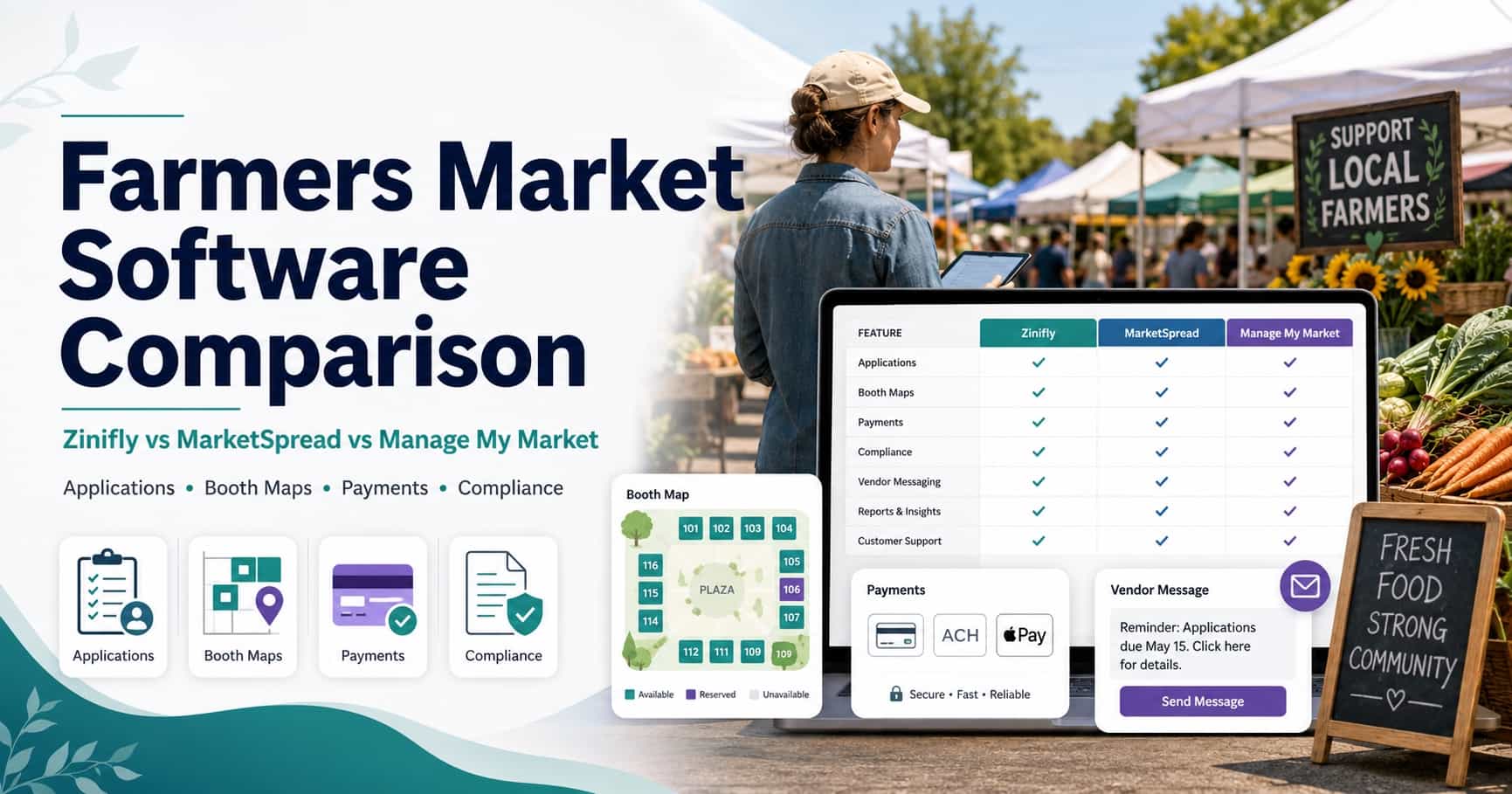
If that sounds familiar, this article is for you. The first half is about why market software pays for itself, whichever product you choose. The second half is an honest comparison of three real options, Zinifly, MarketSpread and Manage My Market, including the cases where Zinifly is not the right answer.
The real cost of running a market by hand
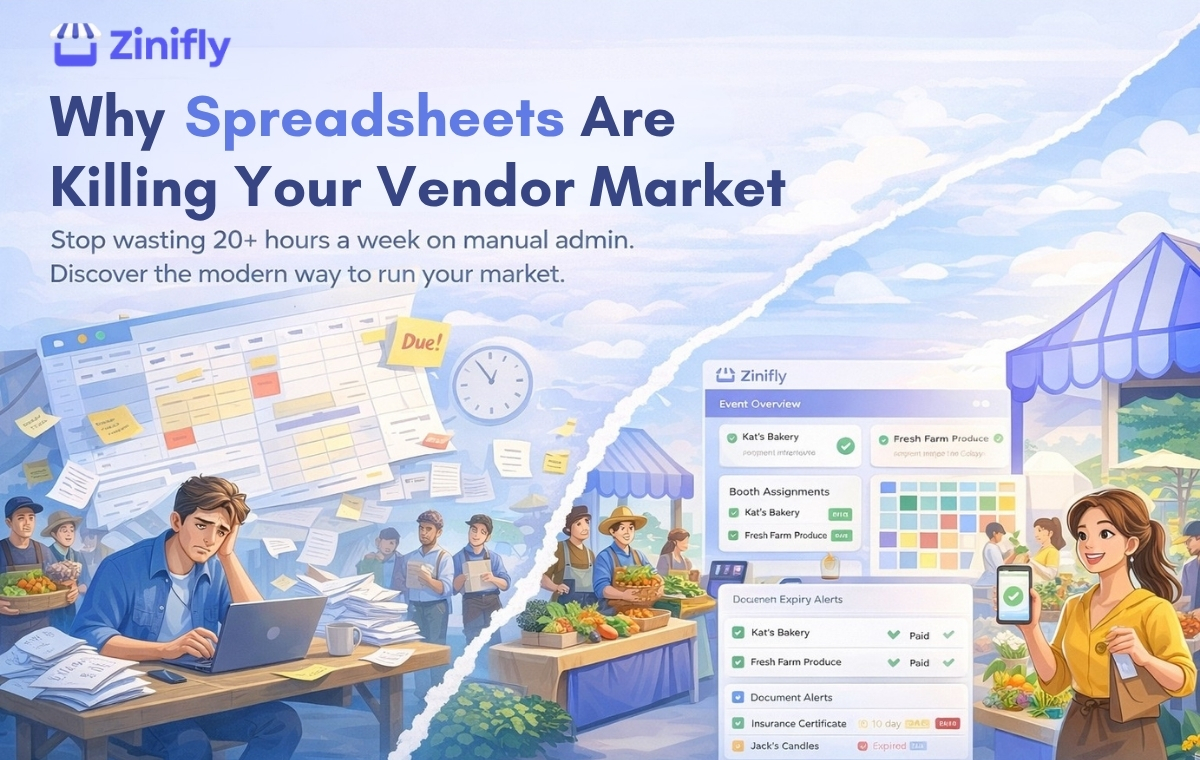
The spreadsheet is not free. It just bills you in hours instead of dollars, and the hours land in the worst possible week, the one before opening day. Here is where they actually go.
1. Applications arrive in five different formats
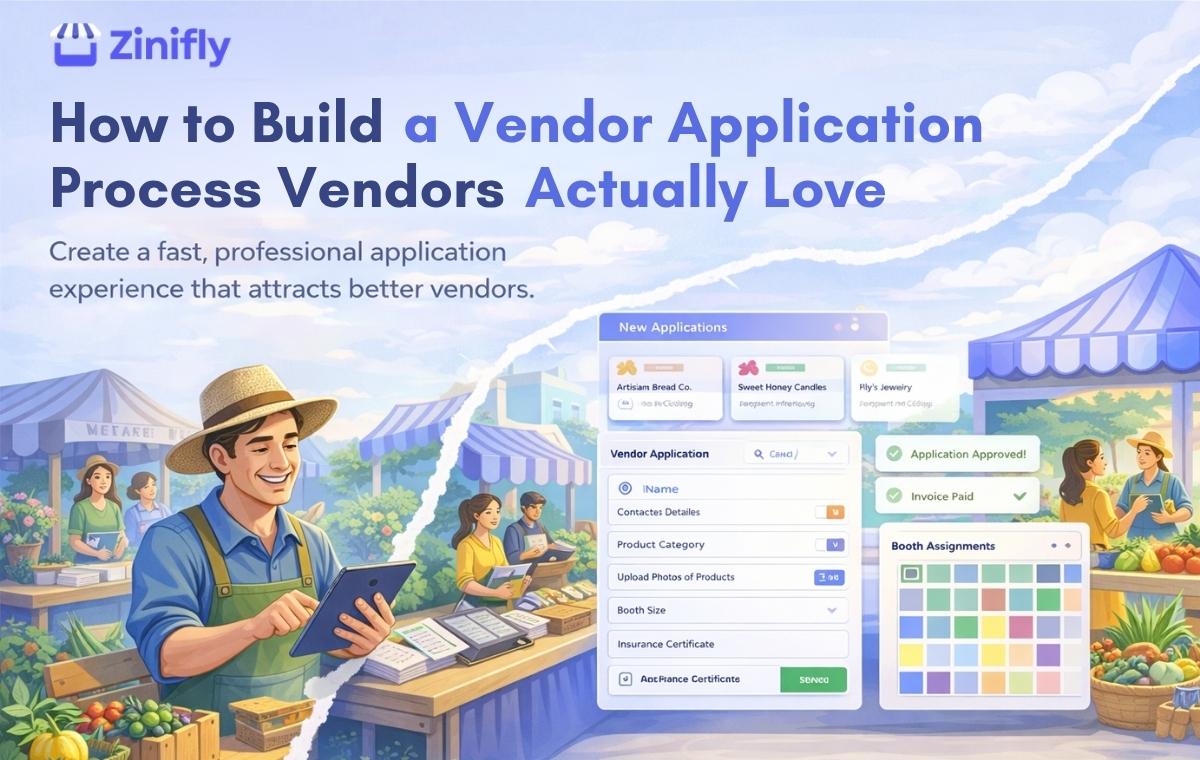
A PDF someone printed, filled in by hand and photographed. A Google Form that stopped matching your rules two seasons ago. Three emails that just say "same as last year." Every one of them has to be read, chased for the missing field, and typed into a master list. A proper application form validates as the vendor fills it in, so what arrives is already complete and already in your system.
2. The map lives in one person's head
Stall assignments are usually a drawing taped inside a binder, redrawn each season, with pencil edits nobody else can read. When that person is away, the market cannot answer "where am I set up?" Software keeps the layout as data — reusable next season, editable by more than one person, and publishable so vendors and shoppers can see it without phoning you.
3. Money arrives in six ways and reconciles in none
Cash on the day, a cheque in the post, an e-transfer with no reference, a card reader that settles two days later. Then someone has to work out who still owes for week nine. Taking booth fees online, with a deposit to hold the space and the balance due later, removes almost all of that. The reconciliation stops being a job because the payment and the booking are the same record.
4. Compliance is discovered on market morning
Food handler certificates, liability insurance, cottage food licences, scale certifications. Nobody wants to turn a vendor away at 7am because their insurance lapsed in June, and nobody wants to be the market that let them trade anyway. Attaching required documents to the vendor, with expiry dates and automatic reminders, moves that conversation to three weeks earlier where it belongs.
5. Communication goes out to everyone or to nobody
Rain plan, gate change, a road closure, one vendor's paperwork. Most markets have exactly two settings: email the entire list, or phone people individually. Being able to message just the vendors at Saturday's market, or just the ones with an outstanding document, is the difference between people reading your messages and filtering them.
6. Nobody can prove the season worked
Boards, city councils, sponsors and grant funders all ask the same questions: how many vendors, how many attended, how much moved through the market, is it growing? If that answer takes a week of spreadsheet archaeology, it usually gets estimated instead — and estimates do not win grants.
A useful way to size the decision: add up the hours you and your team spend each week on applications, assignments, chasing payments and chasing paperwork. Multiply by your season length. Most markets land somewhere between 100 and 300 hours a season. Then compare that with what the software costs. The software is almost never the expensive side of that equation.
What actually separates one product from another
Every market platform will show you vendor applications and a booth map. Those are table stakes. The questions that actually decide which one you live with for five years are narrower:
- Do you get a real website, on your own domain? Or a profile page on their platform? This decides whether shoppers find you or find a directory.
- Whose payment account holds the money? Funds settling into your own processor account is very different from funds passing through someone else's.
- How does the price scale? Per booth, per vendor, or flat? A per-booth fee is cheap for a 12-stall market and expensive for a 90-stall one.
- Does it handle SNAP, WIC or Double Up tokens? If you run a nutrition incentive program, this is not a nice-to-have.
Can you get your data out? Vendors, bookings, payments and history, on demand, in a format you can actually use.

Competitor details are taken from each company's own public website in August 2026 and are summarised in good faith. Products change — confirm the current details with each vendor before you decide, and treat "not advertised" as "we could not verify it," not as "it does not exist."
Where each one is genuinely strong
MarketSpread
MarketSpread is built by people who clearly understand farmers markets specifically. The standout is token tracking — SNAP, WIC, Double Up Food Bucks and similar programs, with end-of-market reconciliation. If your market runs a nutrition incentive program and currently reconciles wooden tokens in a shoebox, that feature alone may decide it. Their booth-and-rental handling is also unusually detailed, down to adjusting rental quantities per vendor per day.
Manage My Market
Manage My Market has been serving markets across 30-plus states and Canada for years, and its best idea is the shared vendor profile: a vendor fills in their details and documents once, then applies to several markets without retyping anything. If you sit inside a regional cluster of markets that already use it, that network effect is real and you should weigh it seriously.
Zinifly
Zinifly starts from a different question. Not "how do we manage a market?" but "how does a market run its whole business?" The market administration is there — applications, approvals, booth maps, documents, payments, messaging — and then it keeps going into the things markets normally buy separately:
- A real website on your own domain. Not a profile inside a directory — your own site, your branding, a certificate issued for you, built from sections you reorder yourself. Shoppers searching for your market land on you.
- Money settles into your account. You connect your own Stripe, Square or PayPal. Vendor sales split to vendors automatically, so there is no month-end reconciliation and no waiting on someone else to pass funds along.
- Vendors get their own storefront. Each vendor has a branded mini-site and shop under your market, with shipping or local pickup — so your market keeps selling between market days.
- A whole season books in one checkout. Vendors pick every date they want from one grid and pay once, with a deposit holding the space and the balance collected later.
- Ticketed events too. Harvest dinners, workshops and festival days with QR check-in and discount codes, run from the same system as your Saturday market.
The pricing difference is worth doing on paper
This is the comparison most markets skip, and it is the one that compounds. MarketSpread publishes a per-booth model: $15 per booth, or $30 per booth for a year-round series. Zinifly publishes a flat subscription: $29, $79 or $199 per month depending on plan.
Those two shapes behave very differently as you grow:

Illustrative only, using each company's published rates in August 2026 and ignoring payment processing fees, which both platforms charge separately. Run your own numbers with your actual stall count — and note that a small market is exactly where the per-booth model looks attractive.
When Zinifly is not the right answer
We would rather tell you now than have you find out in month three.
- You run a SNAP or Double Up token program and reconciliation is your biggest pain. Zinifly does not currently track market tokens or reconcile them at end of market. MarketSpread does. If that is your number one problem, they are the better fit today, and we would rather say so.
- You have twelve stalls, no website ambitions and no online sales. If all you need is a list of vendors and a stall map, a flat monthly subscription may be more platform than you want. Start on our free trial and find out before you commit.
- Your vendors already live inside a regional network on another platform. If every market in your county uses the same system and your vendors apply through one shared profile, that convenience has real value. Weigh it honestly against what you give up.
So who is Zinifly actually for?
Markets that want to stop being administered and start being run as a business. If you want your own website on your own domain, vendors selling online between market days, a season booked and paid in one checkout, ticketed events alongside your Saturday market, and reporting you can hand to a board or a grant funder without a week of spreadsheet work — that is the gap Zinifly is built for, and it is a gap the market-admin tools do not try to fill.
And if you are still weighing it up, the most useful thing you can do is not read another comparison table. It is to put your own market into all three for an afternoon and see which one you stop fighting.
Try it against your own market, free for 14 days
Set up your market, publish your first event and open vendor applications on your own subdomain. No credit card, and we will help move your existing vendor list across.
Sources
- MarketSpread — Farmers Market Management Software (features, payment processing rate, per-booth pricing)
- MarketSpread — Streamline Farmers Market Management (token tracking, SMS and email, booking rules)
- ManageMyMarket.com (vendor applications, stall assignment, maps, shared vendor profiles, coverage)
- Zinifly pricing and Zinifly for farmers markets
Comparisons reflect each company's publicly available information in August 2026. We have tried to represent competitors accurately, including where they beat us. If you work at one of these companies and something here is out of date or wrong, email us and we will correct it.